
Ebrahim Moosa | Palestine Information Network
August 2023
Zambian President Hakainde Hichilema visited Occupied Palestine earlier this month where he was afforded five-star treatment by his Israeli hosts.
The large Zambian delegation led by the president included senior government ministers, and were afforded receptions with no less than the Israeli President Isaac Herzog and Prime Minister Benjamin Netanyahu.
Commenting on his meeting with Netanyahu, an international pariah, Hichilema said he had discussed a wide range of matters of ‘mutual interest’ to Zambians and Israelis. He added that the meeting with Netanyahu emphasized the importance of a bond with the Zionist State, which he indicated, “continues to grow stronger”.
In separate discussions with the Israeli President, Hichilema too expressed gratitude towards Israel, and a keenness to build on existing ties.
During the visit, the Zambians signed several co-operation agreements to strengthen ties in the spheres of medicine, communications, agriculture, and culture.
A significant outcome of the visit was the announcement of a $100 million Israeli investment to establish a power station capable of generating 71 megawatts of electricity in Zambia. The station is being built in Chibombo, a district in the Central Province of Zambia, and will be overseen by the Israeli companies, Gigawatt Global and Gigawatt Wind.
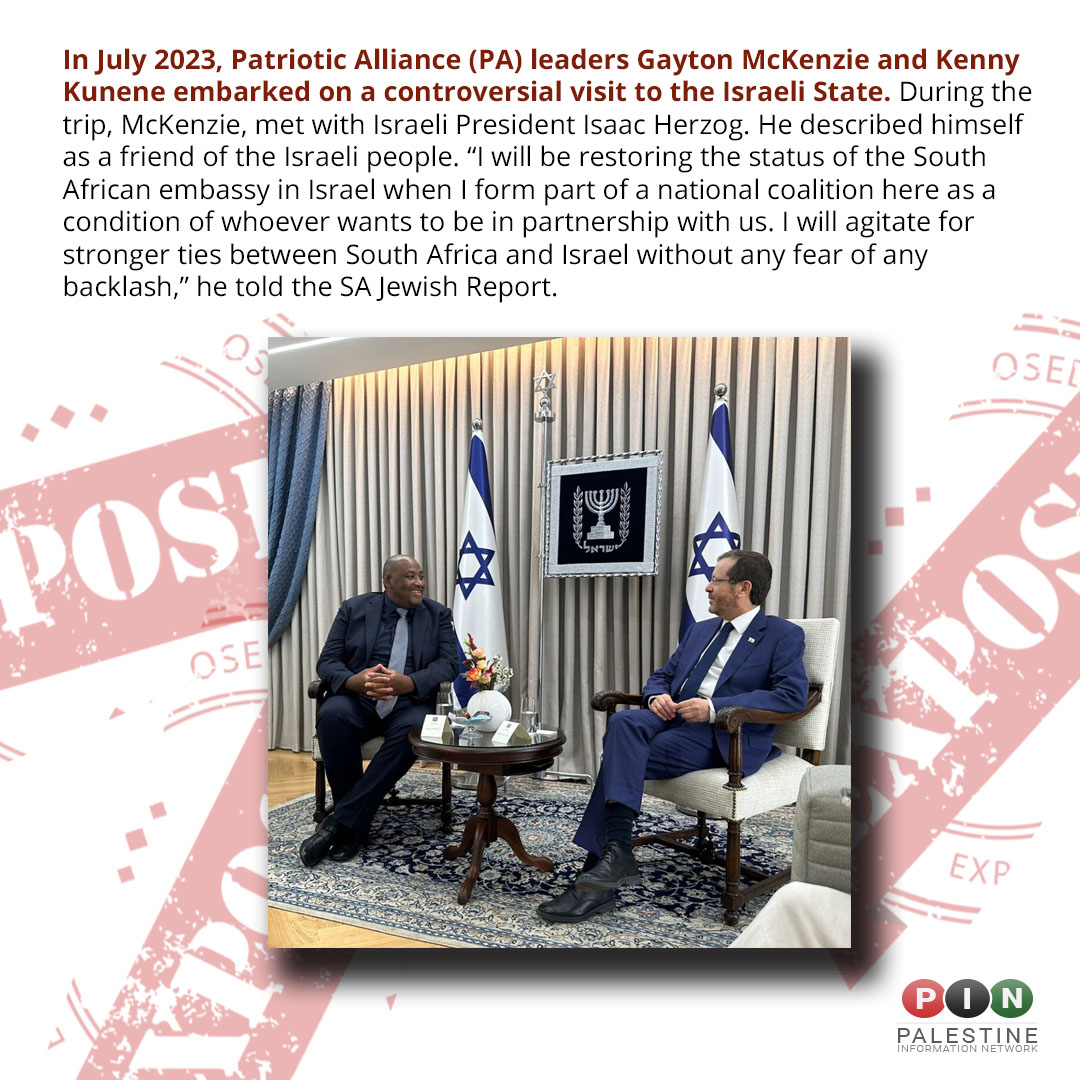
Days before the Zambian President’s visit to the Zionist State, the Israelis had hosted Gayton McKenzie and Kenny Kunene, controversial leaders of the South African political party, the Patriotic Alliance (PA).
Whilst the pair travelled to Occupied Palestine ostensibly to “learn about coalition governments” from the Israelis, the visit had all the hallmarks of a hasbara junket, with the PA leaders returning to South Africa parroting familiar Zionist talking-points.
Mckenzie billed himself a “friend of the Israeli people,” and vowed to restore the status of the South African embassy in Israel were his party to become part of a national governing coalition in South Africa in the future.
He also claimed that Israel – which is notorious for its water theft from Palestinians – could offer lessons on water management that were “appropriate for South Africa”.
Despite evidently embarking on no formal efforts, both prior and during the visit, to engage with Palestinians, the PA leader pontificated that the Palestinians were being harmed by choosing not to speak to Israel, and that the BDS movement, which originated from a grassroots call in Palestine, was “becoming irrelevant” as more and more Muslim countries are starting to work with Israel.
A common thread between Hichilema and McKenzie that was exploited by the Israelis is their attachment to the Christian faith. Capitalising on the spiritual allure of the Holy Land, Biblical texts have been weaponised to confer legitimacy to the modern Zionist State.
“As a Christian, my visit gave meaning to the Bible. I have no regrets about visiting, I will be going back with my family and friends,” McKenzie said.
Israeli PR commonly seeks to portray such normalisation visits as altruistic, with much to be gained by African countries and politicians that strike up mutual relations with Israel. Relations are characterised as being driven by ‘solutions’ Israel can offer the partnering country in fields of technology, agriculture, science, water and health.
But scratching just a little below the surface will reveal much of these perceived benefits to be just a veneer.
In Hichlema’s case, the Israelis were eager to impress upon him the importance of Israel’s role as an observer state at the African Union, and had also asked for Zambia’s help to improve relations between Israel and South Africa. With McKenzie, the Israelis are keeping an eye on the shifting political sands in South Africa, and are keen to cultivate favourable ties with potential future power-brokers.
For all their newfound adulation in Zionist circles, the Hichlemas and McKenzies are just the latest pawns in a long-standing Israeli strategy known as the Periphery Doctrine. This concept calls for Israel to develop close strategic alliances with states away from its immediate neighbourhood in order to counteract the opposition of countries with principled stances vis-à-vis the Occupation, and those supportive of legitimate resistance. The strategy also lessens the Israeli need to rely solely on help from Western Europe or America. The Israeli Foreign Ministry’s focus of late has been on Latin America, Central and Eastern Europe, Asia and Sub-Saharan Africa.
Overtures to its newfound friends have reaped dividends for the Zionists with some of these countries already voting in favour of Israel at the United Nations and inviting Israel to send representatives to conferences they have hosted. Israel has also secured huge economic benefits from these partnerships, as its exports to many emerging economies have soared.
The late Malik al Shabazz (Malcolm X) was pioneering is seeing through this façade when it was first being experimented with in the Zionist State’s fledgling years. Writing in 1964 he observed how the Israeli government had made a series of ‘benevolent’ overtures to African states ”with friendly offers of economic aid and other tempting gifts that they dangle in front of newly independent nations whose economies are experiencing great difficulties.” Al Shabazz even coined a unique term to describe this toxic mix of American imperialism and Israeli interference: ”Zionist dollarism”.