
Ebrahim Moosa | Palestine Information Network
October 2024
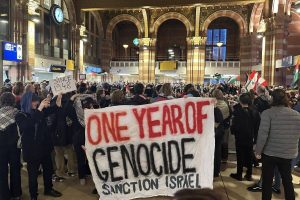
As we mark the one year point in the Gaza genocide, there is arguably nothing markedly different now in terms of ground realities in Gaza from every other day of this onslaught.
The genocide has been unrelenting, and has carried the same hallmarks for every day of the past 12 months. Each day has seen the accrual of martyrs, the demolition of homes, amputation of limbs, everyday struggles to find food, water and medical care, and waves of displacement. When averaged, 53 children have been killed every day since October 7, and 72 men and women are killed in Israeli strikes, every single day.
Palestine, too, has no shortage of other anniversaries that underscore the roots of its ongoing dispossession. The present year marks 107 years since Bayt al-Maqdis was lost to the Islamic Caliphate, and the British gazetted the duplicitous Balfour Declaration. 76 years have also passed since Zionist gangs depopulated 78% of Palestine in the Nakba.
What becomes imperative to consider then, are the implications of marking this litany of grim anniversaries in general, and of one year of unrelenting genocide in particular: How has a Muslim Ummah of two billion strong been so incompetent in rendering assistance to brethren in Gaza in effectual ways, even with the passage of such a lengthy period of time? Have we been consistent in our efforts, or has our focus on Palestine shifted over the course of the past year? Why has the groundswell of public support globally not translated into shifting the burden of oppression faced by Palestinians on the ground?
A Muslim is required to consistently take stock of all his/her actions. Introspection for a Muslim is required before doing any deed, whilst doing it and after doing it, at all times. Introspection should occur both individually and as a collective. This self-examination is required, not only for common acts of worship, but also the broader demands of Muslim brotherhood.
One year on, and as commonplace as Israeli massacres have become, we should never allow scenes of carnage, amputation, beheading by bombs, wanton murder of children and mass casualties to be normalised. Our sense of ukhuwah demands that we do not simply resign ourselves to characterising every massacre as “a normal day in Gaza”. As the analyst Ali Abu Rezeg posits, “If you cannot stop the crime, at least you keep its horror in people’s hearts, reject it, and prevent its repetition from becoming easy. At least let there be some uproar over such killing. Most importantly, through doing this you preserve a small part of the dignity of those who were killed.”
The latest Israeli criminal forays in Lebanon should have us duly alarmed. Our collective failure to stop the Zionist genocidal regime in Gaza is now enabling Israel to commit genocide against the people of Lebanon. And as Jehad Abusalim of the Intstitute for Palestine Studies warns, “if you think it will stop there, you’re wrong.” Israel is seeking to exploit the current circumstances to permanently shift the regional balance of power and restore Israel’s dominance over all its enemies for years, if not decades, to come.
From the very onset of the colonial Zionist project, Israel’s presence in the Muslim heartland had the implication of its neighbours having to choose between slow or rapid annihilation, this due to the racist and expansionist ideology of Zionism. This risk now is greater and even more apparent. As Israel has broken all rules and recalibrated all its calculations, it is grossly insufficient for an Ummah and the peoples of the region to intervene according to the logic of old strategies, oblivious of the radical changes that have taken place in the past year. “Whoever does not move with force and momentum will lose, and stagnation is a certain loss. Watching from afar is also a loss. Hesitation is suicide. Reliance on the international system in suicide, and the absence of proportionate deterrence on the face of such aggression is also suicide.” All our responses should be driven by a realisation that the present is a moment of great transition with concomitant risks and opportunities.
Whilst we ponder our own shortcomings, this anniversary should also be a celebration of the relentless resistance of the inhabitants of Bayt al-Maqdis. We hail the mujahidin of Gaza, the pride of the Ummah, who have held off for an entire year against not only the Israeli genocidal army, but a coalition too of the most advanced militaries from across the Western world. Their valiant stand is a feat nothing short of a miracle.
We pay tribute too to the martyrs of Gaza whose sacrifices have been the catalysts for such great change and opportunities. These martyrs are not simply victims, or cold statistics we incidentally reference. We honour these men, women and children as shuhada – a status they have earned from Allah ﷻ. In shahadah this is continuity – for both the martyr, into the next life, and the community, in their struggle. It is unnerving for the oppressor, that despite their best and continued efforts, they have created a people who are not afraid of death, a people who will not relent till the last day; a force that the Israeli genocidal army simply cannot win against.