
Ebrahim Moosa | Palestine Information Network
October 2023
The dramatic events of October 7, 2023 in Palestine have held the world fixated, and mark a major turning point in the over one century trajectory of injustice in the Blessed Land.
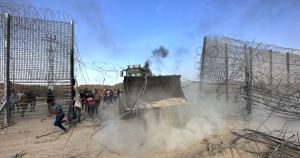
A Palestinian journalist who entered 1948 Occupied Palestine on the fateful Saturday when the Apartheid Israeli smart fence fell described those cherished moments as akin to “a scene out of a movie.”
The sights were “bewildering”. Terrified Israeli soldiers were surrendering to Palestinian fighters. The ‘macho’ men from the ‘dreaded’ Israeli army were now shadows of their former selves as they cowered before members of the Palestinian resistance.
“Those at the border who we had witnessed firing at children and young men, killing us in the past, we were now seeing them at their weakest,” the journalist said.
“I’ve lived all my life under siege, and I’ve covered all the events, wars and the marches of return, and everything related to the Gaza Strip. But this is the first time I felt freedom.”
The journalist recounted how the day felt like Eid. Palestinians began to cry and fall into sujood because they had finally entered the lands that they were displaced from in the Nakba of 1948.
“We were in a state of amazement as we walked around, free, in our lands, outside the prison that is Gaza. We felt that we were in control of our lands.”
October 7, 2023 was the day of the great Gaza prison break.
As dramatic as these events were, for the attuned observer, they hardly come as surprising.
“The human spirit cannot be caged indefinitely,” wrote author Jonathan Cook. “Palestinians in Gaza have been constantly devising new ways to break free from their chains.”
They have built networks of tunnels, developed homemade rockets and missiles with increasing sophistication, and have protested en masse at heavily fortified fences, all amidst nearly two decades of suffocating besiegement enforced by Israel and Egypt.
These strides too, come on the back of dozens of successive popular uprisings across historic Palestine, some dating back to the earliest days of British Occupation of the Holy Land.
Intifadas or shaking off, says commentator Ramzy Baroud, become such “when Palestinian communities mobilise across Palestine, unifying beyond factional and political agendas and carry out a sustained campaign of protests, civil disobedience and other forms of grassroots resistance.”
The fearless wave of resistance that was set off by the likes of Sheikh Izzedeen al Qassam in the Palestinian countryside in the 1930s, has now come of age, with the bewildering feats of the armed resistance brigades which today sports his name.
Given the daringness of the resistance, Israel predictably responded with a campaign of terror, and pronouncements that hardly disguised its genocidal intent in Gaza.
While this reaction is purportedly aimed at battering the enclave back into submission, and has come at an enormous human and humanitarian cost to the Palestinian people, in reality, it represents yet another indicator of Israel’s fragility and its abiding weakness.
To assume that pummelling the Palestinians into submission, moreso in the wake of such a mind-blowing resistance campaign where Israeli have sustained heavy losses, when such a strategy has repeatedly backfired, reveals all about Israel’s myopia.
“The Palestinians’ craving for freedom and dignity will not be diminished,” said Cook. “Another form of resistance, doubtless more brutal still, will emerge.”
As one Israeli analyst observed, regardless of the scale of the Israeli response, Hamas has already won this round. “The fact that it was able to surprise the best and most experienced intelligence services in the world and mock the strongest security system in the Middle East for hours on end will not be erased from the minds of the players in the region.”
The reaction of ordinary Palestinians on the receiving end of this latest campaign of Israeli terror confirms these postulates. Gazan Ziad Musleh lost four of his children along with their spouses and children when an Israeli rocket struck the building they resided in on October 10. While recounting the circumstances of the incident, Musleh echoed a sentiment that is now a common motif across the ruins of Gaza.
“We will not forsake our commitment to Islam, or abandon the resistance. We are all part of the resistance. Palestine is precious, and we will never give it up.”
The unfolding battle appears to be one for the long haul, with a great likelihood of significant regional and international repercussions. And at its heart lies the destiny of Masjid al-Aqsa and the blessed region of Bayt al-Maqdis.
We should grasp the gravity of these developments and understand our required role as the Ummah. It can no longer be ‘business as usual’ for Palestine.