
Ebrahim Moosa | Palestine Information Network
March 2024
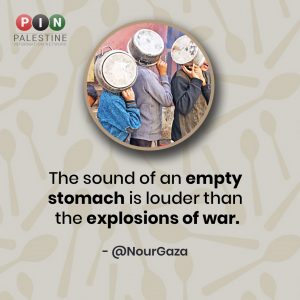
Over the past month, the state of starvation which has been gripping the Gaza Strip has shifted into sharp focus. Even while the genocidal bombs continue to fall, far more ominous has been the brazen war of starvation waged by the Zionist Occupation on the residents of Gaza.
All indications are that the number of Palestinians – moreso children – dying of hunger and malnutrition is on the increase.
Among the war of starvation’s latest reported victims is the 10-year-old child, Yazan al-Kafarna, who passed away in the al-Najjar Hospital in Rafah on March 4. Images shared of Kafarna before his demise show him lying on a hospital bed with sunken cheeks.
Family members revealed that the Israeli siege caused circumstances to deteriorate to the point where Kafarna, who suffered from cerebral palsy from birth, was surviving on just a few morsels of bread a day.
“He was living on scraps of bread we found with great difficulty and brought at extremely high costs. If we couldn’t find food, we would give him sugar just so he could stay alive. The main reason he has reached a point where he just looks like bones, is a lack of nutrition.”
Another young girl passed away after not having access to milk, while yet another, identified as Heba Ziadeh died at a hospital in northern Gaza from dehydration and malnutrition.
Reporting on a visit paid to Rafah in late-February, writer Susan Abulhawa shared how, amidst the Israeli strangulation, Palestinians first resorted to eating horse and donkey feed, but very soon were forced to eat actual donkeys and horses.
“Some are eating stray cats and dogs, which are themselves starving and sometimes feeding on human remains that litter streets where Israeli snipers picked off people who dared to venture within the sight of their scopes. The old and weak have already died of hunger and thirst.
“Flour is scarce and more valuable than gold.
“I heard a story about a man in the north who managed to get his hands on a bag of flour recently normally costing $8 (R150). He was offered jewellery, electronics and cash worth $2,500 (over R46 000) for it. He refused.”
Agnes Callamard, the secretary general of Amnesty International has accused Israeli authorities of “engineering famine” in the Gaza Strip.
“They knew the likely outcome of their actions but persisted, over weeks and months,” she said of Israeli actions.
An audit conducted by Middle East Eye of Israeli behaviour since 26 January has found that the Apartheid regime defied all provisional measures demanded by the International Court of Justice in its much publicised interim ruling.
Among its pronouncements, the court ordered Israel to take immediate measures to enable urgent basic services and humanitarian assistance into Gaza. But since the ruling, the daily average number of trucks entering the Strip has, in fact, only fallen. Between 1 and 26 January, 147 trucks were entering daily, but that fell to 57 between 9 February and 21 February.
It is amidst this dire backdrop that Gaza enters Ramadan. A key objective of Ramadan is to develop piety and self-restraint by abstaining from food and drink during specified hours. Ostensibly, while Ramadan is about abstention and self-denial, ingrained customs have led us to a point where the spirit of the Holy Month has instead become mired by consumption and excess. The calamitous circumstances in Gaza today demand that we urgently exercise a greater sense of self-introspection on how truly we are squaring up to Ramadan’s intended ideals.
Are we consuming food, or are we consumed by food? While Gaza is being starved is it still appropriate for us to be swamped by a foodie culture where the only preoccupation is: Where will we go to next? What will we try next? What is this year’s trendiest savoury? What is the latest gastronomic fad?
Rasulullah ﷺ had emphasized that “He is not a believer whose stomach is full while the neighbour to his side is starving.” (Bayhaqi)
Sayyiduna Umar has offered to humanity a clarion example of the sensitivity and responsiveness required in the face of tragedy through his approach when a famine once afflicted Madinah Munawarrah. Umar wrote to his governors asking them to send food-grains to Arabia. Camel loads of food grains and other necessities came from Syria, Iraq, and Egypt. Meals were cooked at the State level and all people who took refuge in Madinah were fed daily at the State’s expense. According to one account, as many as 40 000 people were fed every day.
Most significantly, for the entire duration of the famine, Sayyiduna Umar abandoned eating of butter and meat in sympathy and solidarity with the starving. He took an oath that he would not eat bread with anything besides olive oil. When his stomach would rumble, he would say: “O stomach you may rumble as much as you like, but as long as the famine persists, I cannot allow you anything dainty”.
While it is true that none of us possess the asceticism of Umar ibn Al-Khattab, the least we can do this Ramadan is to not be tone-deaf to cries of hunger from Gaza. We can all do our part by not wasting our food, practising moderation in our meals and expenditure, and being more socially active in donating and mobilising towards ending the genocide.